
Crises of Cities is Crises of Dignity
Listen on


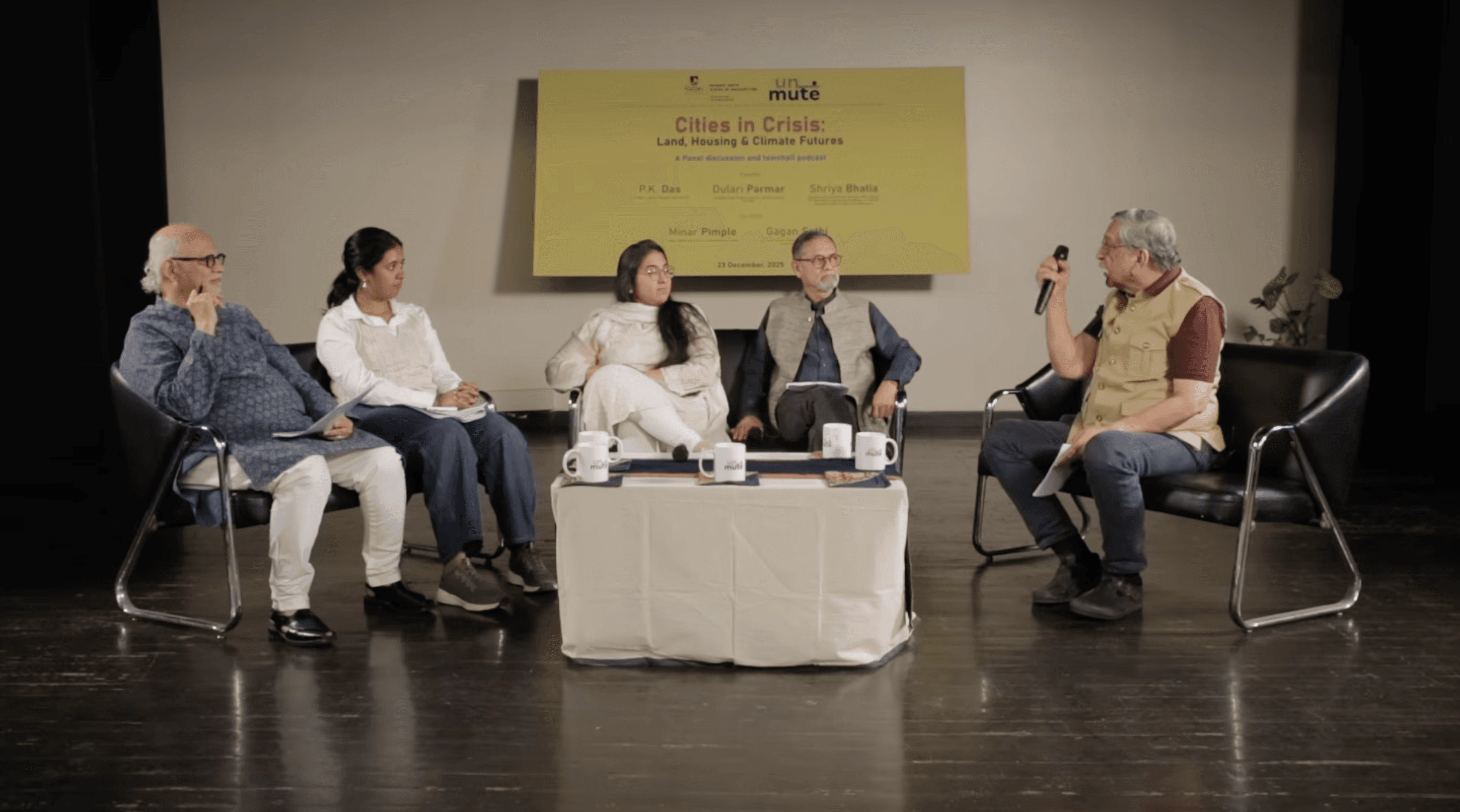
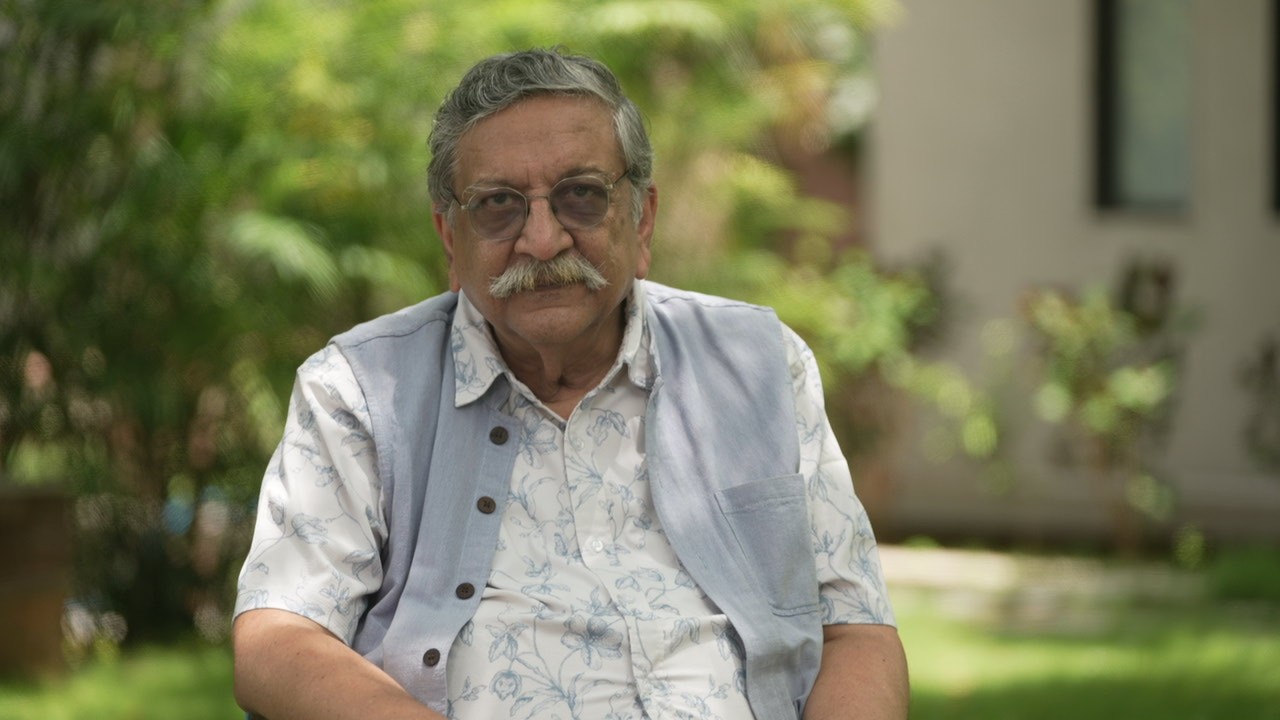
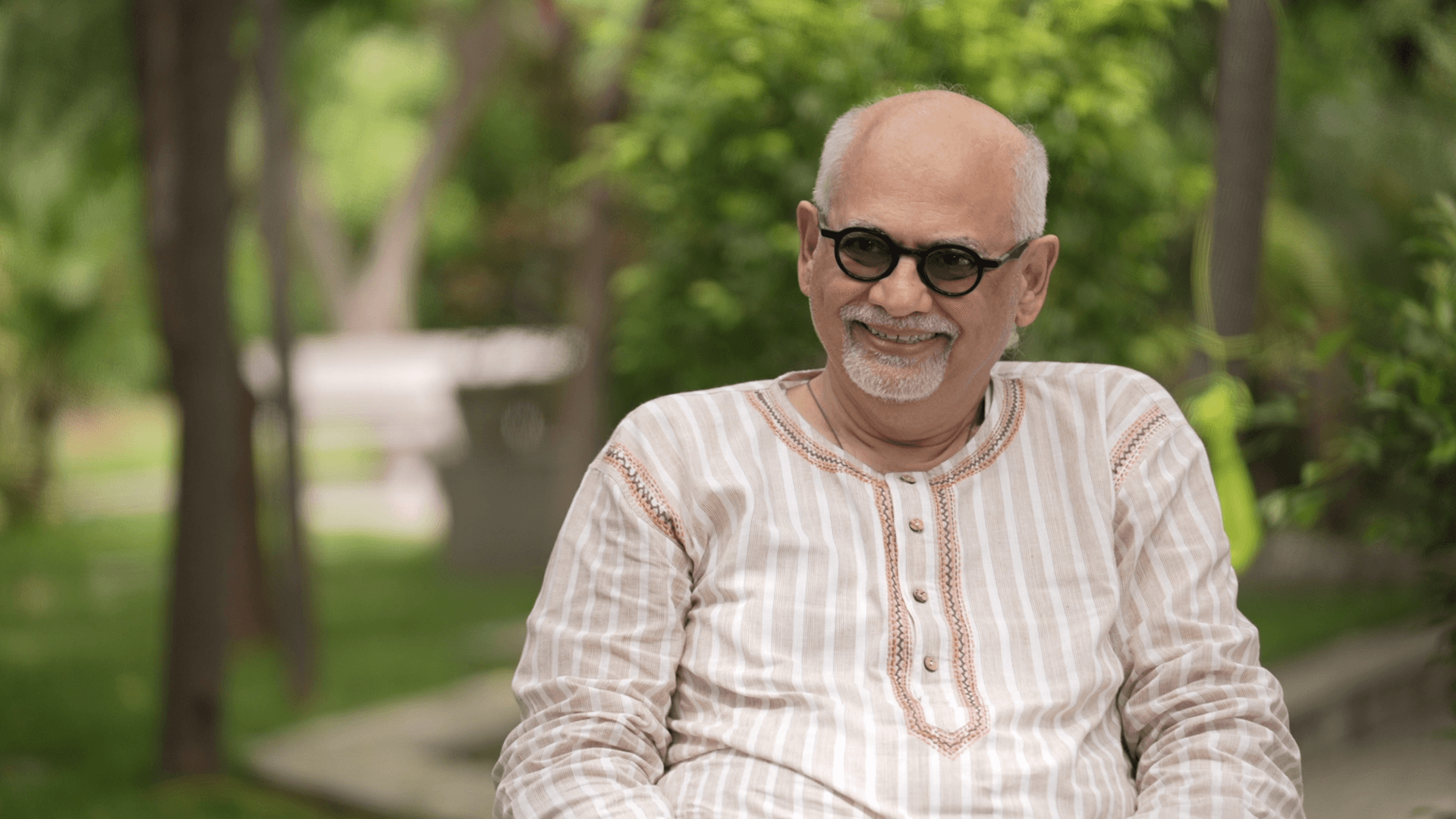
In this Episode of Unmute, hosted with Balwant Sheth School of Architecture, SVKM NMIMS University, as a Town Hall with Students, co-hosts Gagan Sethi and Minar Pimple are joined by P.K. Das, Shriya Bhatia and Dulari Parmar, for a critical discussion on cities in crisis, focusing on the intersectionality of housing, land, and climate futures in the urban domain.
The conversation interrogates the central question of who owns, occupies, and decides the future of cities, situating contemporary urban challenges within broader theoretical frameworks such as Henri Lefebvre’s “right to the city”, alongside work on governance, governmentality, and power by David Harvey and Michel Foucault.
The panel reflects on the deepening intersections between climate crisis, land policies, and housing inequalities, highlighting how urban development increasingly marginalizes vulnerable communities while degrading ecological systems. The episode underscores the need to rethink planning paradigms, foreground people’s agency, and build more inclusive, climate-responsive urban futures through participatory and democratic processes.
Key Highlights
Cities in Crisis: Land, Housing, and Climate Intersections
Urban crises are shaped by overlapping pressures of climate change, housing shortages, and unequitable land distributions, making it necessary to address these issues together rather than in isolation.
Marginalization and the “Inclusionary Deficit”
Contemporary urban development systematically pushes large sections of the populations to the margins, producing what is described as an “inclusionary deficit” in cities.
Segregation Phenomenon as a Defining Urban Process
Urbanization is increasingly characterized by spatial and social segregation between communities and between people and nature leading to fragmented and exclusionary city forms. In turn disrupting symbiotic and interdependent relationships that shape the urban.
Ecological Destruction and Climate Vulnerability
The destruction of mangroves, hills, forests, and other ecological systems is linked to urban expansion, intensifying climate risks such as flooding and heat stress.
From Welfare State to Market-led Urbanism
The role of the State has shifted from provider to facilitator, with planning and development increasingly driven by market forces and private actors. Government merely approves and acts like an executioner.
Privatisation of Cities and Emerging Urban Forms
Gated communities, fragmented cities. New trend of “chartered cites” reflects a broader trend towards privatised urban governance, where profit-driven development overrides social and ecological concerns.
Land as the Core of Power and Inequality
Land is central to economic, social, and political power. Narratives of land scarcity are often used to justify exclusionary policies, redevelopment practices, and capture of forest land, mangroves etc. There is a need to consider land as a common property resource.
Rethinking Informality: Failure and Solution
Informal settlements emerge from the failure of formal planning systems yet also stand for people-led solutions that integrate housing and livelihoods. Their erasure in the name of development raises critical concerns.
From Social Production of Space to Imposed Urban Form and Systemic Destruction of Civil, Civic, and Human Rights
Drawing on thinkers like Henri Lefebvre and David Harvey, the idea that people’s social and cultural lives shape urban space is critically questioned. In the current context, this relationship has weakened, with communities increasingly displaced into standardised vertical housing, reflecting a shift from lived urbanism to imposed, market-driven forms of development. Leading to the destruction of civil, civic, and human rights.
Critique of Slum Redevelopment Models
High-rise rehabilitation models often disrupt social and economic networks, creating “vertical slums” that do not address the realities of work, community, and well-being. Slum redevelopment policy is a land appropriation policy. Need for options of rental housing in addition to ownership-based housing.
Systemic Invisibility and Tokenistic Inclusion
Marginalized communities are often made invisible in planning processes, or included only superficially through maps, and categories. Frameworks such as the Mumbai Climate Action Plan reflect this pattern, where informal settlements are acknowledged but not substantively engaged with.
Rise of Think Tanks and the Politics of Knowledge Production
The growing influence of policy think tanks in the climate and urban space is reshaping how urban issues are framed. These institutions often produce top-down knowledge that overlooks lived realities, raising questions about who defines vulnerability and whose knowledge informs policy.
Institutional Gaps and Fragmented Planning Systems
Urban planning is marked by fragmented governance structures and siloed approaches across sectors such as housing, climate, and infrastructure. This lack of integration combined with withdrawal of state from planning, increasing reliance on consultants, weakens accountability and limits the ability to respond to complex urban challenges.
Avoidance of ‘Messy’ Realities in Planning
Urban informality and lived vulnerability are complex and difficult to standardise, planning processes often avoid this “messiness”, favouring simplified, technocratic solutions that do not engage with ground realities. Similar experiences are now visible in the climate space as well.
Climate Justice, Climate Action, and Differential Impacts
Climate change disproportionately affects the urban poor, especially women and marginalised groups, underscoring how vulnerability is shaped by intersecting inequalities. Climate action needs to go beyond symbolic efforts such as beach clean ups and move towards investing in climate resilient housing and more inclusive, equity oriented urban planning.
Maladaptation and Inequities in Climate Finance
City-level planning responses often produce maladaptive outcomes, while global climate funding stays disproportionately structured, limiting meaningful support to urban poor.
Building with Nature, Not Over It
The discussion emphasises the need to shift from extractive, engineering-led approaches toward ecological planning that works with natural systems.
Revisiting Architecture as Practice and Profession
The discussion calls for rethinking architecture and planning beyond technocratic, market driven roles, towards practices that are socially embedded, ecologically responsive, and accountable to peoples lived realities.
People’s Agency and the Right to the City
Reclaiming urban futures requires strengthening people’s agency, ensuring visibility, foregrounding local knowledge, and asserting rights to land, housing, and participation in shaping cities. This includes advancing more equitable forms of density, embedding participatory planning processes, and enabling forms of creative dissent.
References and Resources:
Youth for Unity and Voluntary Action (YUVA): yuvaindia.org
Nivara Hakk: https://www.nivarahakk.com/
PKDA Architects: https://pkdas.com/
Balwant Sheth School of Architecture
Hunnarshala, climate friendly housing system: http://www.hunnarshala.org/
New Definition of Aravalli Hills and Weakening of Environmental Protection: https://theleaflet.in/environment/how-the-supreme-courts-new-definition-of-the-aravalli-redraws-the-landscape-of-indias-oldest-hill-range
Aravalli Hills https://india.mongabay.com/2025/12/with-a-new-identity-the-aravalli-hills-stare-at-an-uncertain-future/
Destruction of Mangroves for Coastal Road: https://timesofindia.indiatimes.com/india/can-cut-46k-mangroves-for-mumbai-project-sc/articleshow/129711620.cms
Versova–Bhayander Coastal Road project https://www.timesnownews.com/mumbai/mumbai-versovabhayander-coastal-road-project-gets-green-light-all-you-need-to-know-article-153287049
Right to the City, David Harvey: https://davidharvey.org/media/righttothecity.pdf
Possible Worlds: Henri Lefebvre and Right to the City, journal article by Mark Purcell (2013): https://faculty.washington.edu/mpurcell/jua_rtc.pdf
Climate Justice: https://climatepromise.undp.org/news-and-stories/climate-change-matter-justice-heres-why
How local communities can assert voice in mapping (2025): https://questionofcities.org/research-how-local-communities-can-assert-voice-in-mapping/
The Maharashtra Regional and Town Planning Act, 1966: https://www.indiacode.nic.in/bitstream/123456789/16117/5/town.pdf
Maharashtra Coastal Zone Management Authority (CZMA): https://mczma.gov.in/czmp
Coastal Zone Management Plan (CZMP): https://mczma.gov.in/czmp
Mumbai Climate Action Plan: https://wri-india.org/initiatives/mumbai-climate-action-plan-mcap
Housing and Dishousing in Mumbai- A Historical Outline of Slum Discourse and Policy, Hussain Indorewala (2018): https://www.academia.edu/37683970/Housing_and_Dishousing_in_Mumbai_A_Historical_Outline_of_Slum_Discourse_and_Policy
Irla Nallah Re-invigoration Project: https://pkdas.com/published/The-Irla-Nullah-Re-invigoration-Project.pdf
Mumbai’s ‘Designed for Death’ Buildings Are Incubating TB (2018): https://science.thewire.in/health/how-mumbais-designed-for-death-buildings-are-manufacturing-tb-hotspots/
Urban Heat Islands: https://www.sciencedirect.com/science/article/pii/S1877705816332039
Narrative Change, YUVA: https://yuvaindia.org/narrative-change/
Mumbai’s Open Spaces Map: https://pkdas.com/maps/1-Mumbai's%20Open%20Spaces%20Map.pdf
Mithi River Rejuvenation Project: https://timesofindia.indiatimes.com/city/mumbai/adani-group-now-bags-bid-for-1-7k-cr-mithi-river-rejuvenation-project/articleshow/125618704.cms
Committee for the Right to Housing (CRH): https://crhmumbai.org/
Bombay Environmental Action Group (BEAG): https://beag.in/
Draft Zonal Master Plan (ZMP) for the Eco-Sensitive Zone (ESZ) of Sanjay Gandhi National Park: https://mahaforest.gov.in/writereaddata/fckimagefile/SGNP%20ZMP%20GR%20and%20Report-pages-2.pdf
Climate Justice, YUVA: https://yuvaindia.org/climate-justice/
Rental Housing, MMRDA: https://mmrda.maharashtra.gov.in/en/division/rental-housing/overview#gsc.tab=0
Affordable Rental Housing Complexes: https://arhc.mohua.gov.in/
Panvel Development Plan, YUVA: https://questionofcities.org/after-cop29-lessons-and-actions-for-urban-poor-and-climate-justice/
Guwahati Development Plan, YUVA: https://assamtribune.com/opinion/draft-guwahati-master-plan-2045-sparks-concerns-on-displacement-affordable-housing-location-1593478
Navi Mumbai Development Plan, YUVA: https://yuvaindia.org/coming-together-for-a-more-inclusive-navi-mumbai-development-plan-2018-2038-2/
National Urban Housing and Habitat Policy: https://www.nhb.org.in/Urban_Housing/HousingPolicy2007.pdf
Question of Cities: https://questionofcities.org/
Constitution of India: https://www.legislative.gov.in/static/uploads/2025/07/ca7ce5c746fa7480804bbdeb6cb704f0.pdf
Global Climate Funds Report: https://www.downtoearth.org.in/climate-change/only-35-per-cent-of-global-climate-finance-reaches-urban-poor-report-2
Co Hosts
Gagan Sethi: Development practitioner and social justice advocate with 40+ years of experience in organisational development, policy advocacy, and minority rights.
Minar Pimple: Human Rights Advocate, Development leader and Founder of YUVA (Youth for Unity and Voluntary Action), and former senior Director at Amnesty International, Regional Director-Asia Pacific (UN Millennium Campaign) and Founding Chair, Oxfam India.
Guests
PK Das: Architect-activist who is known for his work on housing rights, public spaces and inclusive urban development. His practice focuses on participatory planning and ecological approaches to city-making.
Shriya Bhatia: Associate Professor at Balwant Sheth School of Architecture, SVKM’s NMIMS Deemed to be University, whose work focuses on urban planning systems, governance structures, and the institutional dynamics shaping cities.
Dulari Parmar: Architect and climate justice practitioner at YUVA whose work is at the intersection of climate action, housing, and land with special focus on youth.
MC
Dhanashri Sawant: Associate Professor, Balwant Sheth School of Architecture, SVKM’s NMIMS University