Episode 15 Design as a Force for Justice: Learning, Craft, and the Purpose of Education


Listen on


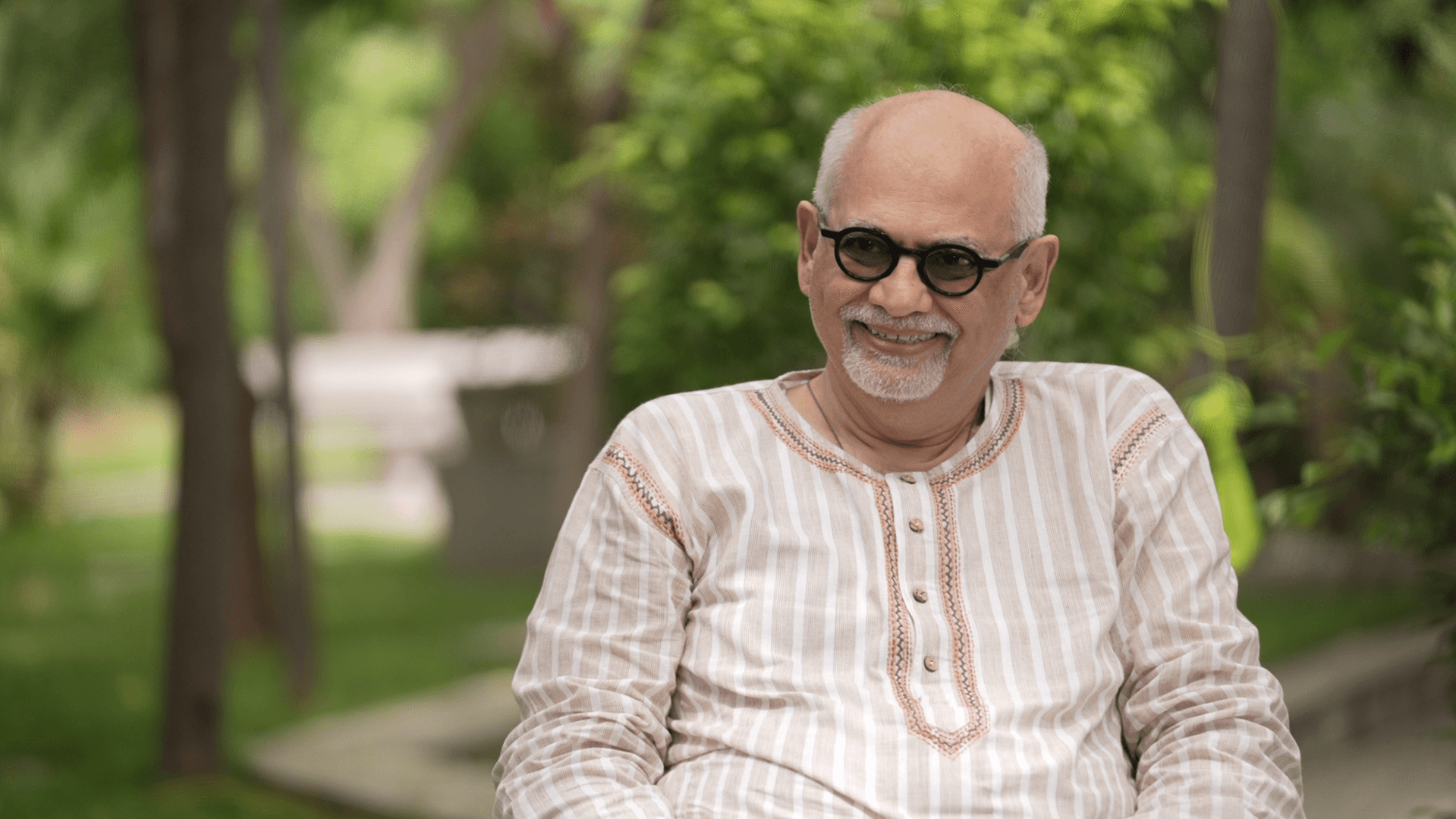
In this episode of UnMute, hosts Gagan Sethi and Minar Pimple speak with Ashoke Chatterjee about a remarkable journey spanning industry, international public service, design education, craft traditions and social development.
Drawing on his 25 years at the National Institute of Design (NID) and more than five decades of engagement with the Jawaja experiment, Ashoke reflects on how design can respond to poverty, oppression, and the everyday realities of people’s lives.
The conversation revisits origins of NID and its distinctive approach to education, one rooted in learning by doing, experimentation, field engagement and the ability to move between different worlds of need. Through the Jawaja experience in Rajasthan, design education encountered caste, oppression, precarious livelihoods, access to water and the economic realties of craft production. Working alongside artisans challenged conventional ideas of design and brought questions of markets quality, marketing and fair returns into the classroom.
The discussion also examines what has happened to design education and public institutions, the growing influence of market-driven approaches, and the importance of protecting educational spaces that encourage independent thinking and meaningful engagement in society.
Ashoke reflects on development as the ability of people to make choices and realise them, the changing relationship between craft and caste, and the possibilities and uncertainties that artificial intelligence presents for human creativity and craft communities.
The episode closes with a reflection on civil society itself: moving beyind labels and institutional categories to ask what values guide our work, who benefits from our decisions, and what responsibilities we are willing to take.
This is a conversation about design, education, institutional purpose, and the enduring importance of learning from people and their lived realities.
Key Highlights
Solidarity is not always an act of courage; sometimes it is simply about showing up:
Reflecting on his visit to Jantar Mantar, Ashoke resists the framing of his presence there as an act of courage. He describes it instead as an act of solidarity: making the effort to be present, register his support, and stand alongside people who are speaking out. The encounter also brought him into conversation with young people whose commitment reminded him of the original ethos of the National Institute of Design (NID). For Ashoke, the experience raises a larger question about the importance of protecting spaces for independent thought, excellence, and public engagement.
The pursuit of quality demands an unwavering commitment to one’s choices:
Ashoke traces an important lesson in commitment to his encounter with the classical dancer Shanta Rao. Her dedication to her art, and his own long effort to document her work, taught him what it means to remain unflinching in one’s choices, even when doing so comes at a personal cost. He reflects on how this lesson extends beyond performing arts: the pursuit of quality in any field requires conviction, persistence, and a willingness to accept the consequences of one’s decisions.
New ideas often require bringing together people and disciplines that established institutions keep apart:
Ashoke’s experience at the India Tourism Development Corporation (ITDC) illustrates an early attempt to use design as a distinctive proposition for India. The initiative brought together people from hospitality, tourism, crafts, architecture, landscape design, advertising, and communication to rethink how India could present itself to the world. It encountered resistance from both the bureaucracy and the private sector, which were unaccustomed to this kind of cross-disciplinary approach. Although the experiment eventually collapsed, it demonstrated the possibilities of bringing creative people and different forms of expertise together around a shared purpose.
Building an institution requires defending its founding vision, particularly when the vision is misunderstood:
Ashoke recalls the early years of NID, when the idea of establishing an industrial design institute in India was questioned. The institution faced internal disagreements and external pressures, including suggestions that it was an irrelevant or imported concept. The intervention of people such as Romesh Thapar and others reaffirmed the institution’s original vision and direction. His reflections point to a larger challenge for educational institutions: their purpose cannot be reduced to administrative survival or the credentials they award; they must retain the intellectual independence and experimental spirit that make new forms of learning possible.
Design must engage with poverty, inequality, and power rather than remain confined to questions of form and function:
The Jawaja experiment, which brought together NID and the Indian Institute of Management Ahmedabad (IIMA), challenged conventional boundaries between design education, management, and development. Working with leather workers and weavers meant confronting the realities of poverty, caste, occupational hierarchies and unequal access to resources. Ashoke makes the point that design is political because the choices designers make about what they produce, whose knowledge they recognise and whose needs they respond to have consequences for people’s lives and livelihoods. Jawaja demonstrated that design could become a means of engaging with structural inequalities rather than simply improving products.
Supporting artisan livelihoods requires attention to the entire chain, from production to markets and fair returns:
The experience at Jawaja made clear that improving the quality or design of a craft product is not enough. Artisans who need support with product development, costing, pricing, marketing and access to markets. These are not peripheral concerns: if products do not sell, or if the returns do not adequately reach the artisans, the intervention cannot sustain their livelihoods. The conversation therefore challenges a narrow understanding of design as a technical or creative input and places economic viability, the distribution of value and the dignity of artisan work at the centre of the process.
Meaningful learning can emerge from sustained engagement with communities, even when it does not produce an immediate, tangible output:
Ashoke reflects on the importance of experiential learning in the Jawaja experiment. Students and teachers had to spend time with artisans, observe their working conditions, understand their contexts and document what they were learning. The value of this process could not always be measured through a finished product or an immediate intervention. It required a willingness to remain with uncertainty, learn from experience and realities. This offers a different a different understanding of educational outcomes, one that values the process of learning as much as its visible results.
Design is fundamentally an act of service: it requires seeing the world through the eyes of others:
Ashoke draws a distinction between design and art, while recognising the importance of aesthetics and creativity in both. For him, design is a form of service that begins with understanding the needs and circumstances of others. A designer cannot simply impose personal preferences or assumptions; the work must respond to the people who will use or experience it. This understanding also shaped NID’s pedagogy, where students learnt by making, demonstrating, testing, and revising their work in response to clients. Design, in this sense, is not only about what a designer creates but about how well they understand and respond to the world around them.
Design education must develop the capacity to work across diverse contexts, not simply produce formal qualifications:
Ashoke recalls the distinctive approach to design education developed at NID, where learning by doing and working across different contexts of need were central to the pedagogy. He refers to the international recognition of the Indian design experiment, including the 1979 United Nations design conference, which highlighted the ability of Indian practitioners to work across diverse situations. He also questions the growing emphasis on formal degrees and credentials in design education, and the tendency to use terms such as design thinking without necessarily retaining the practices of making, testing, and learning through experience. His reflections invite a broader debate about what education should enable people to do, beyond the qualifications they acquire.
Development should expand people’s choices, not merely provide infrastructure or preserve existing occupations:
The conversation moves beyond conventional measures of development to consider whether people have the ability to make meaningful choices about their lives. Ashoke illustrates this through the example of a young person choosing to pursue weaving. There is a significant difference between practicing a traditional occupation because there are no alternatives and choosing it as a livelihood with dignity and purpose. Development, therefore, should not simply preserve existing livelihoods or provide material infrastructure; it should expand people’s agency and enable them to decide what kind of lives they want to lead.
Changing who participates in craft can challenge inherited caste and occupational boundaries:
The discussion of craft also raises questions about caste and the social organization of work. Ashoke reflects on the significance of younger people entering craft traditions even when they do not come from communities historically associated with those occupations. Such changes can begin to unsettle the assumption that particular skills and forms of work belong to particular castes. Equally important is the possibility of reciprocal recognition between artisans and designers: recognising that knowledge does not flow in only one direction, and that the experience and expertise of artisans are as important to the design process as formal design education.
Artificial intelligence raises questions about who controls knowledge, creativity, and the value created through craft:
Ashoke approaches the growing presence of artificial intelligence in creative work through questions of human agency and values. The possibilities of new technologies need to be considered alongside concerns about authorship, intellectual property, and the ownership of knowledge. These questions become particularly important when technology draws on forms of knowledge and creativity developed by craft communities over generations. The challenge is not simply whether artisans and designers should engage with AI, but whether they can do so without losing control over their work, knowledge, and creative contributions.
The autonomy of educational institutions is essential to protecting experimentation and intellectual freedom:
Returning to NID, Ashoke reflects on the pressures that public institutions face from bureaucratic control, changing administrative priorities and corporate influence. He questions whether the increasing emphasis on formal qualifications and regulatory frameworks can adequately accommodate institutions whose purpose is to experiment with different ways of learning and producing knowledge. His reflections also locate Indian design education within a longer intellectual tradition, referring to the educational experiments associated with Rabindranath Tagore and Visva-Bharati. The larger concern is how institutions can retain their founding purpose and independence while responding to the changing social and educational contexts.
The value of civil society lies in the principles it upholds, the interests it serves and its willingness to remain accountable:
In the concluding discussion, Ashoke questions the tendency to assess organisations through labels such as corporate, NGO, or Gandhian. These categories, on their own, reveal little about the values that guide an organization or the consequences of its actions. What matters is what people and institutions are willing to stand for, whose interests they serve and how they remain accountable. The conversation brings this back to the responsibility of civil society: to engage critically with society and institutions, remain guided by a sense of public purpose, and sustain values such as civility and fraternity in the pursuit of social change.
References and Resources
Ashoke Chatterjee: https://nid.edu/insight2018/speakers.php
National Institute of Design: https://www.nid.edu/home.html
Ravi Matthai: https://archives.iima.ac.in/faculty/Ravi-J-Matthai.html
Indian Institute of Management Ahmedabad (IIMA): https://www.iima.ac.in/
The Jawaja Experiment: http://millennialmatriarchs.com/2022/08/16/the-jawaja-project/
The Jawaja Project: https://gaatha.org/Craft-of-India/jewaja-leather-craft-story/
Indian Tourism Development Corporation: https://itdc.co.in/
Visva Bharati: https://www.visvabharati.ac.in/home/
Craft Council of India: https://www.craftscouncilofindia.in/
Centre for Heritage Management, Ahmedabad University: https://ahduni.edu.in/academics/schools-centres/centre-for-heritage-management/
International Monetary Fund: https://www.imf.org/en/home
Gandhi Ashram: https://www.gandhiashramsabarmati.org/en/
Inception of NID: https://thinkmatter.in/2024/04/19/an-indian-experiment-of-global-relevance/
Prof Yash Pal: https://en.wikipedia.org/wiki/Yash_Pal
Shanta Rao: https://www.india-seminar.com/2015/676/676_ashoke_chatterjee.htm
Amartya Sen’s Capabilities Approach: https://www.civilsdaily.com/news/development-means-expansion-of-choices-in-amartya-sens-capabilities-approach/
Ivan Illich: https://www.britannica.com/biography/Ivan-Illich
Dances of the Golden Hall: https://www.abebooks.com/9780861444441/Dances-Golden-Hall-Chatterjee-Ashoke-0861444442/plp
Rising Utthan: https://www.amazon.in/Rissing-Uthan-Ashok-Chatterjee/dp/9380740026?s=bazaar
Constitution of India:
https://www.legislative.gov.in/static/uploads/2025/07/ca7ce5c746fa7480804bbdeb6cb704f0.pdf
Question of Cities: https://questionofcities.org/
Guest
Prof. Ashoke Chatterjee is a renowned design advocate, communicator, educator, and author whose career bridges design, public service, and grassroots social change. Educated at Woodstock School, St. Stephen’s College and Miami University (Ohio), his early career spanned engineering, the International Monetary Fund (Washington D.C), and the India Tourism Development Corporation. He went on to serve the National Institute of Design, Ahmedbad, for 25 years as Executive Director, Senior Faculty, and Professor of Communication and Management, shaping design education across India and Pakistan. A lifelong champion of Indian artisans and cultural heritage, Prof. Chatterjee served as Honorary President of the Crafts Council of India for over two decades (and continues as Honorary Advisor), alongside board roles with Aid to Artisans, INTACH, and the Madras Crafts Foundation. His extensive development work with organisations like UNICEF, the Water Supply & Sanitation Collaborative Council, Utthan and the Prabhat Education Foundation focuses on drinking water, sanitation, disability inclusion, education, and rural livelihoods. Also an accomplished author of works including Dances of the Golden Hall and Rising, he continues to write, teach, and advise institutions from his home in Ahmedabad.