
Labour Codes

Listen on


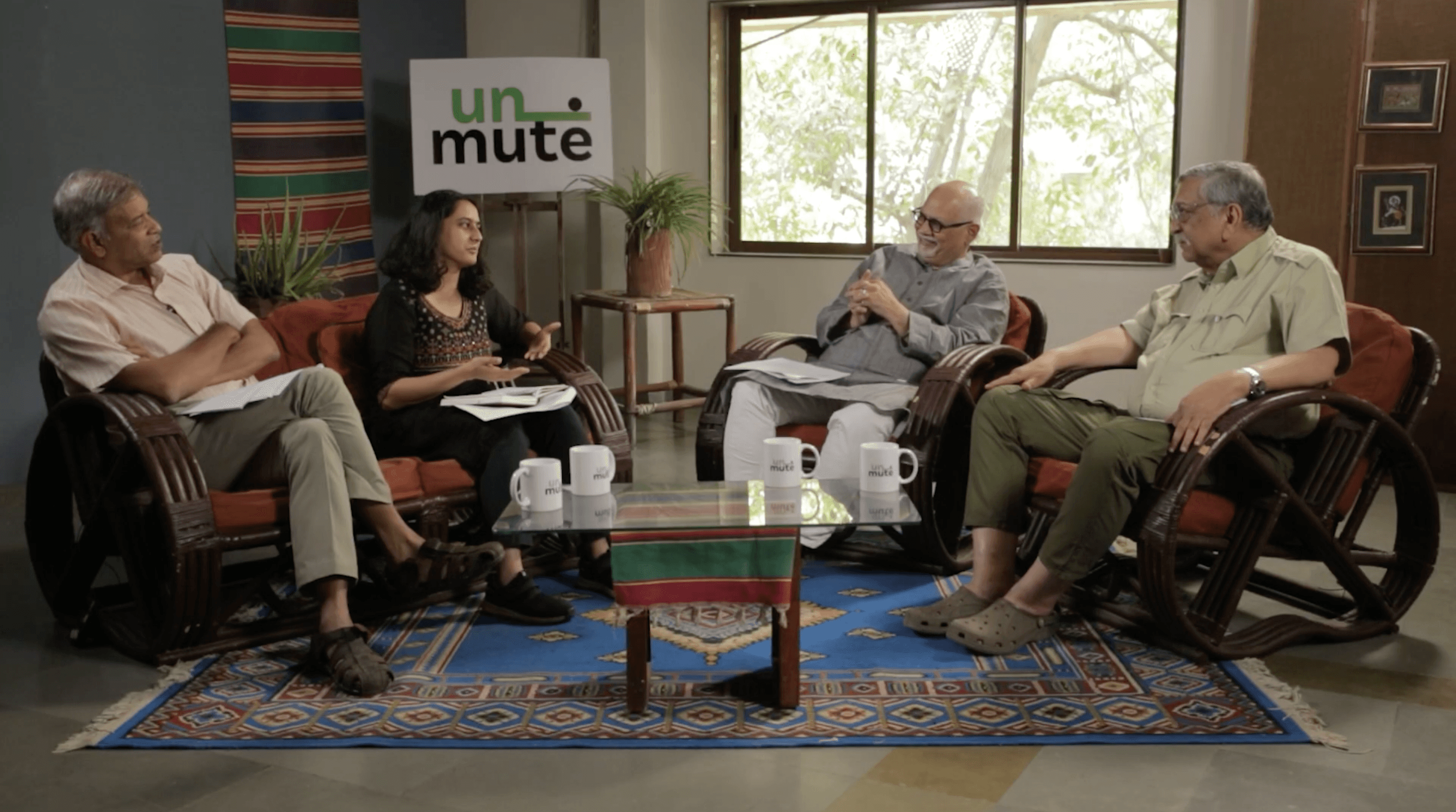
In this episode of Unmute, the hosts Minar Pimple and Gagan Sethi are joined by Prof. Ernesto Noronha and Anusha Ravishankar for a critical discussion examining the changing economy and the changing world of labour in India. Through discussions on labour codes, informal work, migrant labour, gig economies, trade unions, social security, and the future of work under platform capitalism and artificial intelligence, the conversation reflects on how labour precarity is being institutionalised through policy reforms, fragmented production systems, weakened collective bargaining, and shrinking democratic spaces.
Drawing from field experiences, labour research, legal practice, and worker organising, the discussion explores the realities of wage theft, bonded labour, gig work, migrant vulnerability, and the limits of existing welfare mechanisms. The episode also reflects on the role of trade unions, civil society, and collective organising in responding to growing inequalities, state repression, and emerging challenges such as climate transition and algorithmic control.
At its core, the conversation asks an urgent question: How can solidarity, labour rights, and democratic accountability be rebuilt in an increasingly fragmented and precarious world of work?
Key Highlights
Labour Codes and Institutionalised Precarity
New labour codes deepen labour precarity rather than strengthen worker protections. Provisions related to layoffs, retrenchment, fixed-term employment, and thresholds for legal applicability are seen as weakening job security and reducing the accountability of employers.
The labour codes are also discussed as part of a broader political-economic shift aimed at attracting investment and improving “ease of doing business”, often at the cost of collective bargaining and workers’ rights.
Weakening Trade Unions and Collective Bargaining
There is a gradual weakening of the trade unions and organised labour. While recognition of unions has formally expanded, new procedural requirements around strikes and conciliation processes are viewed as mechanisms that can effectively criminalise labour action.
The conversation highlights how restrictions on organising reduce workers’ bargaining power and contribute to fragmented forms of resistance where workers increasingly shift jobs instead of collectively negotiating workplace conditions.
Informality, Migrant Labour, and Structural Vulnerability
Informality is not accidental but structurally produced through weak labour protection, subcontracting systems, and fragmented protection networks. Migrant workers are particularly vulnerable because they remain socially and politically “disembedded” from the cities and regions where they work. Examples from construction work, brick kilns, and industrial clusters demonstrate how exploitation persists because workers often lack alternatives, legal remedies, or social security support. Migration itself becomes tied to survival under conditions of unemployment and rural distress.
Social Security: Welfare or Rights?
The discussion critically examines the promise of universal social security under the labour codes. Many welfare provisions remain discretionary, fragmented, and difficult to access, rather than enforceable rights. Initiatives such as E-Shram registration and welfare boards are discussed as important but limited mechanisms that often suffer from bureaucratic delays, poor implementation, underutilised funds, and a lack of accountability. The distinction between welfare as charity and welfare as rights-based entitlement emerges as a key theme.
Bonded Labour, Wage Theft, and Everyday Exploitation
Exploitative labour relations continue in both visible and hidden forms. Wage theft, delayed compensation, unsafe workplaces, and forms of economic bondage remain widespread across sectors. Even when laws formally exist, workers often cannot pursue legal remedies because of delays, financial vulnerability, fear of retaliation, and weak enforcement systems. Legal processes themselves become inaccessible for precarious workers.
Gig Work and Platform Capitalism
Gig work is a contemporary extension of precarious labour. Platforms are criticised for presenting workers as “independent contractors” while exercising significant control over their work, wages, performance, and visibility through algorithmic systems. The discussion raises important questions about employee status, platform accountability, algorithmic control, declining wages, excessive work hours, and lack of social protection. Gig work is similar to older forms of piece-rate and informal labour. Thus, platform economies reproduce long-standing patterns of labour fragmentation under new technological forms.
Urban Governance and the Invisible Worker
An important thread in the episode is the relationship between labour and the city. Speakers argue that urban planning and governance rarely recognise the everyday needs of workers, despite cities depending heavily on their labour. Questions around shelters, sanitation, drinking water, resting spaces, affordable food, and social infrastructure for gig workers and naka workers are issues of urban justice rather than merely labour welfare. Workers are often treated as extractable labour rather than as citizens with rights to the city.
Fragmented Governance and “Suspended” Spaces
Industrial zones, special economic zones, and rapidly urbanising regions often become spaces where governance responsibilities are unclear or weakened. Even where large worker populations exist, access to public health centres, schools, housing, and welfare infrastructure remains inadequate. These industrial landscapes are described as “suspended spaces of governance” where labour is concentrated but civic rights remain absent or ambiguous.
Labour Research, Knowledge Production, and Shrinking Democratic Space
Declining visibility of labour research in public discourse and media. Academic publishing pressures, global ranking systems, and shrinking institutional space for dissent are identified as reasons why grounded labour research is becoming accessible.
There are issues with regard to censorship, state repression, and pressures to produce “balanced” narratives that avoid challenging dominant political and economic structures.
Collaborations between academics, civil society groups, and worker organisations are important in producing socially relevant research.
Trade Unions, Identity, and New Forms of Collectivisation
The discussion explores whether traditional trade union structures remain adequate in the present moment marked by caste, gender, religion, migration, and identity-based fragmentation. There is a need for broader forms of collectivisation that can engage with both class inequalities and identity-based discrimination simultaneously. Possible models of solidarity across social divisions that one can draw from are farmer movements, dock worker unions, and community organising.
Climate Transition and the Future of Labour
The future of labour is discussed in relation to climate change, technological shifts, and artificial intelligence. The idea of “just transition” emerges as a major concern: as economies move away from coal and carbon-intensive sectors, workers risk losing livelihoods unless transitions are socially and economically just. AI and automation are discussed as forces likely to reshape employment, particularly routinised and platform-based work. The questions of data ownership, algorithmic transparency, and digital control are identified as emerging labour struggles.
Rebuilding Solidarity and Collective Futures
Civil society, labour organisations, researchers, and communities must resist fragmented and donor-driven approaches that isolate issues from larger structural struggles. There is a need for rebuilding democratic spaces, strengthening collective organising, and creating broader alliances capable of responding to labour precarity, state repression, technological change, and social fragmentation.
References & Resources
The Industrial Relations Code, 2020: https://prsindia.org/files/bills_acts/bills_parliament/2020/Industrial%20Relations%20Code,%202020.pdf
The Code of Wages, 2019: https://www.indiacode.nic.in/bitstream/123456789/15793/1/aA2019-29.pdf
The Code on Social Security, 2020: https://upload.indiacode.nic.in/view-casepdf?type=act&id=AC_CEN_6_0_00036_202036_1623221080799
The Occupational Safety, Health and Working Conditions Code, 2020: https://dgfasli.gov.in/public/Admin/Cms/AllPdf/650059fbb8f1a9.98699174.pdf
Compliance Handbook for Employers Under the Four Labour Codes (Central Government Sphere) https://www.labour.gov.in/static/uploads/2026/02/83978455025732b99b0165def80ab171.pdf
The Industrial Relations (Central) Rules, 2026: https://www.labour.gov.in/static/uploads/2026/05/f05a2c220dcdec0ea9c55e84d9ff791f.pdf
The Code on Wages (Central) Rules, 2026: https://www.labour.gov.in/static/uploads/2026/05/6eb0c35ba63b776487a025e5123b6b12.pdf
The Social Security (Central) Rules, 2026: https://www.labour.gov.in/static/uploads/2026/05/49aa9b62c2125499c37399b90e969d67.pdf
Occupational Safety, Health and Working Conditions (Central) Rules, 2026: https://www.labour.gov.in/static/uploads/2026/05/ee246f790cad0b8e99c3828f34fa09a6.pdf
Centre for Social Justice: https://centreforsocialjustice.net/Desktop/Home
India Labour Line: https://indialabourline.org/
World Bank- Ease of Doing Business Rankings: https://archive.doingbusiness.org/en/rankings
Make in India, Ease of Doing Business: https://archive.doingbusiness.org/en/rankings
The Digital Blueprint for Ease of Doing Business: https://www.pib.gov.in/PressNoteDetails.aspx?id=157735&NoteId=157735&ModuleId=3®=3&lang=2
Department for Promotion of Industry and Internal Trade: https://www.dpiit.gov.in/ministry/about-us/details/Title=Ease-of-Doing-Business-(EODB)-ITMwETMtQWa
Designed to Exclude: Legal Architecture of Informality in India: https://www.livelaw.in/articles/legal-architecture-labour-law-523397
The Employee’s Compensation Act, 1923: https://www.indiacode.nic.in/bitstream/123456789/13197/1/the-employees-compensation-act_1923.pdf
Social Protection for Informal Workers: https://www.wiego.org/informal-economy/articles/social-protection-informal-workers/
Social Protection for Informal Workers, ILO: https://share.google/SUDRl1oEAbMGO2TkW
Code on Social Security, 2020: Towards Universal and Inclusive Social Protection: https://www.pib.gov.in/FactsheetDetails.aspx?Id=150473®=3&lang=2
Informal Workers in India: A Statistical Profile: https://www.wiego.org/wp-content/uploads/2020/10/WIEGO_Statistical_Brief_N24_India.pdf
Statistical Picture- Informal Economy: https://www.wiego.org/informal-economy/statistical-picture/#section-5
Social Security and Informal Workers: A Comparative Study of Brazil, China, Germany, and India: https://www.actionaidindia.org/wp-content/uploads/2022/09/Social-Security-Monograph-I-E-book.pdf
Social Security for Informal Workers in India (Policy Brief): https://cprindia.org/wp-content/uploads/2021/12/Brief_SocialSecurity_InformalWorkers_21Nov2020.pdf
International Labour Standards: https://www.ilo.org/international-labour-standards
Overview of ILO’s Framework for Measuring Decent Work: https://share.google/KFxuXBmQ9g4if0JS5
The Inter-State Migrant Workmen (Regulation of Employment and Conditions of Service) Act, 1979: https://www.indiacode.nic.in/bitstream/123456789/13209/1/the_inter-state_migrant_workmen_regulation_of_employment_and_conditions__of_service_act_1979.pdf
Report on Conditions of Work and Promotion of Livelihoods in the Unorganised Sector (NCEUS): https://sanhati.com/wp-content/uploads/2013/10/NCEUS-2007-Report-on-conditions-of-work-and-promotion-of-livelihoods-in-the-unorganised-sector.pdf
E-Shram Portal: https://eshram.gov.in/
Building and Other Construction Workers’ (Regulation of Employment and Conditions of Service) Act, 1996: https://www.indiacode.nic.in/bitstream/123456789/7682/1/building-and-other-construction-workers-act-1996.pdf
Workers fight for right to the city: https://questionofcities.org/
Policy Brief (YUVA): Ensuring relief through the Building and Other Construction Workers Welfare Board (BOCW-WB): https://yuvaindia.org/wp-content/uploads/2023/03/Policy-Brief-Construction-Workers.pdf
Policy Brief (YUVA): Ensuring Dignified Livelihoods and Social Security for Informal Workers (Including Migrant Workers): http://yuvaindia.org/wp-content/uploads/2023/04/Policy-Brief-Informal-Workers.pdf
ILO, Future of Work Issue Briefs: https://www.ilo.org/topics/future-work/future-work-issue-briefs
Artificial Intelligence Impact on Labour Markets- Literature Review: https://www.iedconline.org/clientuploads/EDRP%20Logos/AI_Impact_on_Labor_Markets.pdf
The Future of Work Podcast (ILO): https://voices.ilo.org/podcast
Guidelines and policy frameworks for just transition of the workforce and the creation of decent work and quality jobs: https://unfccc.int/documents/648793
Climate Change and Labour: Impacts of Heat in the Workplace: https://www.undp.org/publications/climate-change-and-labor-impacts-heat-workplace
Problems and Miseries of Migrant Workers vs Union of India & Ors. (PIL): https://indiankanoon.org/doc/139315795/
The Historic nation-wide railway strike of May 1974: https://www.groundxero.in/2024/05/07/the-historic-nation-wide-railway-strike-of-may-1974/
Gig Workers Association (GigWA): https://gigwa.org/
All India Gig and Platform Workers Union: https://aigpwu.in/
The Draft Telangana Gig and Platform Workers (Registration, Social Security, and Welfare) Bill, 2025: https://prsindia.org/bills/states/the-draft-telangana-gig-and-platform-workers-registration-social-security-and-welfare-bill-2025
Platform work and the employment relationship (ILO): https://webapps.ilo.org/static/english/intserv/working-papers/wp027/index.html
Uber BV and others (Appellants) v Aslam and others (Respondents): https://www.supremecourt.uk/cases/uksc-2019-0029
Thousands of Just Eat couriers launch legal action to improve workers’s rights: https://www.theguardian.com/business/2026/may/04/just-eat-couriers-launch-legal-action-improve-workers-rights
Placing platform workers in the city’s urban imagination: https://questionofcities.org/placing-platform-workers-in-the-citys-urban-imagination/
Nae Pasaran Documentary: https://vimeo.com/182246588
New Battle in Panipat as refinery workers rise: https://questionofcities.org/new-battle-in-panipat-as-refinery-workers-rise/
Constitution of India: https://www.legislative.gov.in/static/uploads/2025/07/ca7ce5c746fa7480804bbdeb6cb704f0.pdf
Policy Brief on Domestic Workers, YUVA, 2025: https://yuvaindia.org/wp-content/uploads/2025/05/Policy-Brief-on-Domestic-Work.pdf
Hosts
Gagan Sethi: Development practitioner and social justice advocate with 40+ years of experience in organisational development, policy advocacy, and minority rights.
Minar Pimple: Human Rights Advocate, Development leader and Founder of YUVA (Youth for Unity and Voluntary Action), and former Senior Director at Amnesty International, Regional Director-Asia Pacific (UN Millennium Campaign) and Founding Chair, Oxfam India.
Guests
Prof. Ernesto Noronha is a Professor of Organisational Behaviour at the Indian Institute of Management, Ahmedabad, specialising in the areas of globalisation and employment relations, workplace diversity and inclusion. His globally recognised and widely cited research spans informal work, organisational control, and workplace harassment. A visual sociologist interested in photography, he is known for positivist and visual methodologies and holds key editorial roles, including Section Editor at the Journal of Business Ethics. He actively collaborates with industry, trade unions, and civil society, and contributes to labour well-being through initiatives like Social Compact and Centre for Labour Research and Action (CLRA).
Anusha Ravishankar is a lawyer currently working with India Labour Line (ILI), a pro bono helpline addressing issues of wage theft, injury compensation, etc. of informal workers in India. She is also closely associated with the Centre for Social Justice (CSJ) and conducts action research on labour rights.